The Role of Corruption in Facilitating Extortion Racket Systems
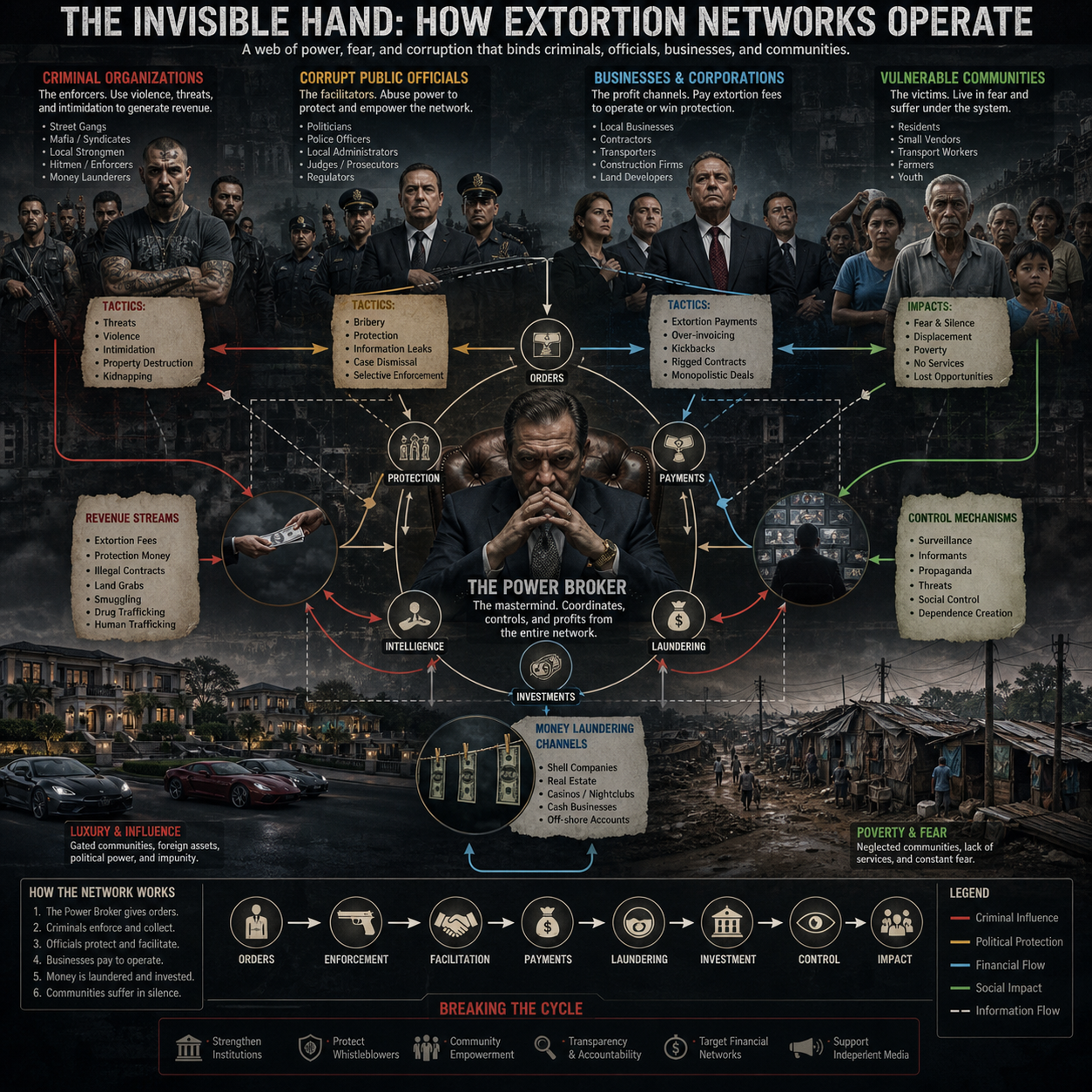
Extortion racket systems depend on coercion, but coercion alone rarely explains their durability. Threats and violence may extract an immediate payment; corruption can create the conditions that allow the same network to operate repeatedly, avoid scrutiny, and expand into legitimate markets. In organized crime research, this makes corruption a form of infrastructure: it lowers risk, protects relationships, and weakens the institutions that victims might otherwise rely on.
Defining Extortion Rackets and Corruption
An extortion racket is a continuing scheme in which criminal actors use threats, violence, damaging information, or other coercive pressure to obtain money, services, property, or compliance. Corruption is the abuse of entrusted authority for private or collective gain, and it can help such schemes function without being the direct source of the threat.
Extortion differs from ordinary bribery because the victim in an extortion scheme is compelled to pay. A bribe typically involves an exchange in which a person offers an improper benefit to influence an official decision. An extortion payment, often called a protection payment, is extracted under pressure. The payer may be promised safety from the very harm that the criminal group causes or threatens to permit.
Fraud relies primarily on deception, while extortion relies on coercive leverage. In practice, these categories can overlap. A criminal network may use fraud to identify vulnerable businesses, violence to enforce payment, and corruption to prevent effective investigation. Corruption therefore acts as an enabling, protective, or sustaining factor rather than a universal cause.
How Corruption Creates Operating Space for Criminal Networks
Corruption creates operating space for criminal networks by reducing the perceived probability of detection, prosecution, or retaliation. Compromised public officials, regulatory gaps, and selective enforcement can turn a dangerous illegal activity into a stable local system.
The first effect is risk reduction. If officials ignore unlicensed businesses controlled by a criminal group, delay inspections, or warn suspects about planned enforcement, the network gains time and predictability. Even small acts of facilitation can matter when repeated across police, licensing, courts, taxation, and procurement agencies.
The second effect is territorial or sectoral access. Criminal groups may use corrupt relationships to enter construction, transport, waste management, nightlife, public contracting, or informal markets. They can pressure businesses to pay while presenting the arrangement as a routine cost of operating. This blurs the boundary between criminal governance and ordinary administration.
A useful research framework is the three-part operating space model:
- Access: corruption gives criminal actors information, permits, contracts, or introductions.
- Protection: it weakens inspections, arrests, prosecutions, or asset recovery.
- Normalization: it makes coercive payments appear unavoidable and reduces public resistance.
These functions do not always require senior officials. A network of low-level facilitators can produce significant institutional weakness when no agency has a complete view of the pattern.
Key Corruption Mechanisms in Extortion Systems
Corruption supports extortion systems through bribery, collusion, information sharing, falsified records, contract manipulation, and interference with accountability. The common feature is that an entrusted process becomes a tool for protecting coercive extraction.
Bribery and protection arrangements
Bribery may buy non-enforcement, favorable licensing decisions, reduced penalties, or access to confidential databases. In other cases, officials receive regular payments in exchange for maintaining a protection arrangement. The arrangement can be explicit, but it may also rely on gifts, employment promises, political support, or reciprocal favors.
Information leaks and falsified records
Information leaks can warn criminal groups about raids, witnesses, surveillance, or pending regulatory action. Falsified records may hide ownership, alter inspection results, misclassify transactions, or make a coercive enterprise appear commercially legitimate. These practices are especially damaging because they contaminate the evidence needed to establish relationships between criminal networks and public officials.
Contract manipulation and investigative interference
Contract manipulation can provide criminally connected firms with market power, subcontracting opportunities, or access to businesses that later face pressure to pay. Investigative interference includes misplaced files, unexplained delays, selective charging, pressure on prosecutors, and obstruction of justice. Each act may appear administrative in isolation, yet together they can produce institutional capture, where formal institutions serve the interests of a network rather than the public.
Choosing informal cooperation for short-term stability often means accepting long-term loss of oversight. Once corrupt actors depend on the network’s income, dismantling the arrangement becomes harder than preventing its initial formation.
The Relationship Between Criminal Groups and State or Private Actors
Extortion-related corruption is usually a networked process involving criminal groups, public officials, police, private intermediaries, businesses, and local power brokers. No single actor must control the entire system for corruption to protect organized crime.
Criminal groups provide coercive capacity and access to illicit revenue. Public officials may provide permits, warnings, enforcement decisions, or administrative cover. Police officers can facilitate the scheme through selective enforcement, while prosecutors or court personnel may weaken accountability. Private intermediaries, including brokers, consultants, security providers, and business figures, can connect the criminal network to formal institutions without appearing to be direct participants.
Businesses occupy varied positions. Some participate willingly because corruption offers competitive advantage or protection from rivals. Others comply under duress. Treating all businesses as collaborators can therefore misidentify victims and obscure the coercive structure of the racket.
Local power brokers may mediate disputes, collect payments, or influence elections and public appointments. Their role shows why corruption should not be reduced to a simple exchange of cash for favors. It can involve collusion, coercion, kinship, political dependency, and shared economic interests. The key analytical question is who controls decisions, who benefits, and who bears the risk when the arrangement is exposed.
How Corruption Sustains Victim Silence and Institutional Impunity
Victims often remain silent because corruption makes reporting appear unsafe, futile, or economically destructive. Retaliation risks, witness intimidation, and distrust of law enforcement can preserve an extortion system even when many people know it exists.
A business owner may fear physical harm, permit cancellation, tax scrutiny, damage to reputation, or retaliation against employees and relatives. If previous complaints produced no action, the victim may reasonably conclude that the criminal network has institutional protection. In some settings, the complaint process itself may expose the victim’s identity to compromised officials.
Witness intimidation is especially powerful when combined with corruption. A witness does not need to receive a direct threat if confidential information routinely reaches suspects or if earlier witnesses lose employment, face harassment, or encounter unexplained legal problems. Silence then becomes a rational survival strategy rather than evidence that no crime occurred.
Complaint systems also fail when they demand that victims provide evidence they cannot safely obtain. Effective responses separate initial reporting from local actors who may be compromised, protect confidentiality, offer relocation or security support where appropriate, and provide realistic timelines. Reporting channels alone do little when institutions cannot demonstrate that retaliation will be detected and punished.

Consequences for Governance, Markets, and Communities
Corruption linked to extortion weakens governance, distorts markets, reduces public trust, and concentrates harm among vulnerable populations. Its effects extend well beyond the money extracted from individual victims.
Public institutions lose legitimacy when people believe that access, safety, or justice depends on payment. Law enforcement becomes selective, and honest officials face pressure from both criminal actors and colleagues who benefit from the arrangement. Over time, institutional capture can redirect public resources toward politically connected firms and away from communities with the greatest needs.
Markets also become distorted. Businesses that refuse protection payments may lose contracts, face fabricated violations, or withdraw from an area. Firms willing to cooperate can gain an unfair advantage, while consumers absorb higher costs and reduced choice. The result resembles a hidden tax administered through coercion rather than transparent public policy.
Communities experience damaged social trust, reduced investment, labor exploitation, and unequal access to public services. Migrants, informal workers, small traders, and politically marginalized groups may face the greatest exposure because they have fewer legal protections and less ability to absorb financial loss. The consequences are therefore both economic and civic: extortion teaches residents that authority belongs to whoever can enforce payment.
Investigative and Prevention Approaches
Authorities can address corruption supporting extortion by combining financial investigation, independent oversight, victim protection, interagency cooperation, transparent procurement, and credible accountability. No single reform is sufficient because the system crosses institutional boundaries.
Financial investigators should examine unexplained wealth, recurring payments, beneficial ownership, procurement patterns, and links among officials, intermediaries, and businesses. Financial intelligence can reveal relationships that individual victim statements cannot safely establish. Investigators should also compare complaints, inspection decisions, contract awards, and enforcement outcomes across time and location.
Prevention measures include:
- Independent oversight: empower inspectorates, audit bodies, and anti-corruption agencies to investigate without local political interference.
- Whistleblower protection: provide confidential reporting, anti-retaliation remedies, and secure channels outside the suspected chain of command.
- Transparent procurement: publish ownership information, tender decisions, contract amendments, and subcontracting relationships where lawful.
- Interagency cooperation: connect police, prosecutors, tax authorities, financial intelligence units, labor regulators, and procurement bodies.
- Victim-centered enforcement: reduce dependence on a single witness and offer practical protection, legal advice, and business continuity support.
Reforms also require measurement. Useful indicators include investigation delays, unexplained case withdrawals, repeated awards to connected firms, complaints by sector, and disciplinary outcomes. External standards such as the United Nations Office on Drugs and Crime’s anti-corruption resources can support institutional design, but local risk assessments remain essential.
A common mistake is treating corruption as an isolated ethics problem. The stronger approach maps the full system: coercive actors, administrative vulnerabilities, financial flows, victims, and points where independent review can interrupt the cycle.
Frequently Asked Questions
What is the connection between corruption and extortion?
Corruption can protect extortion by reducing enforcement risk, supplying confidential information, legitimizing criminal access to markets, and obstructing investigations. Extortion may occur without corruption, but corrupt relationships can make it more durable and scalable.
How do corrupt officials facilitate extortion rackets?
They may accept bribes, leak information, falsify records, manipulate permits or contracts, ignore violations, interfere with investigations, or pressure witnesses. Facilitation can be direct or indirect and may involve officials at several levels.
Why are extortion victims often reluctant to report?
Victims may fear retaliation, witness intimidation, business closure, exposure of confidential information, or ineffective law enforcement. When institutions appear captured, silence can seem safer than cooperation.
How can authorities detect corruption linked to organized crime?
Authorities can combine financial investigations with procurement analysis, complaint mapping, unexplained enforcement patterns, beneficial-ownership checks, protected witness evidence, and cross-agency intelligence. Patterns are often more revealing than a single transaction.
What measures can reduce institutional capture?
Independent oversight, transparent procurement, protected reporting, staff rotation in high-risk functions, conflict-of-interest controls, interagency cooperation, and meaningful sanctions can reduce institutional capture. These measures work best when agencies publish outcomes and protect victims from retaliation.