Money Laundering Channels in Extortion-Based Organized Crime
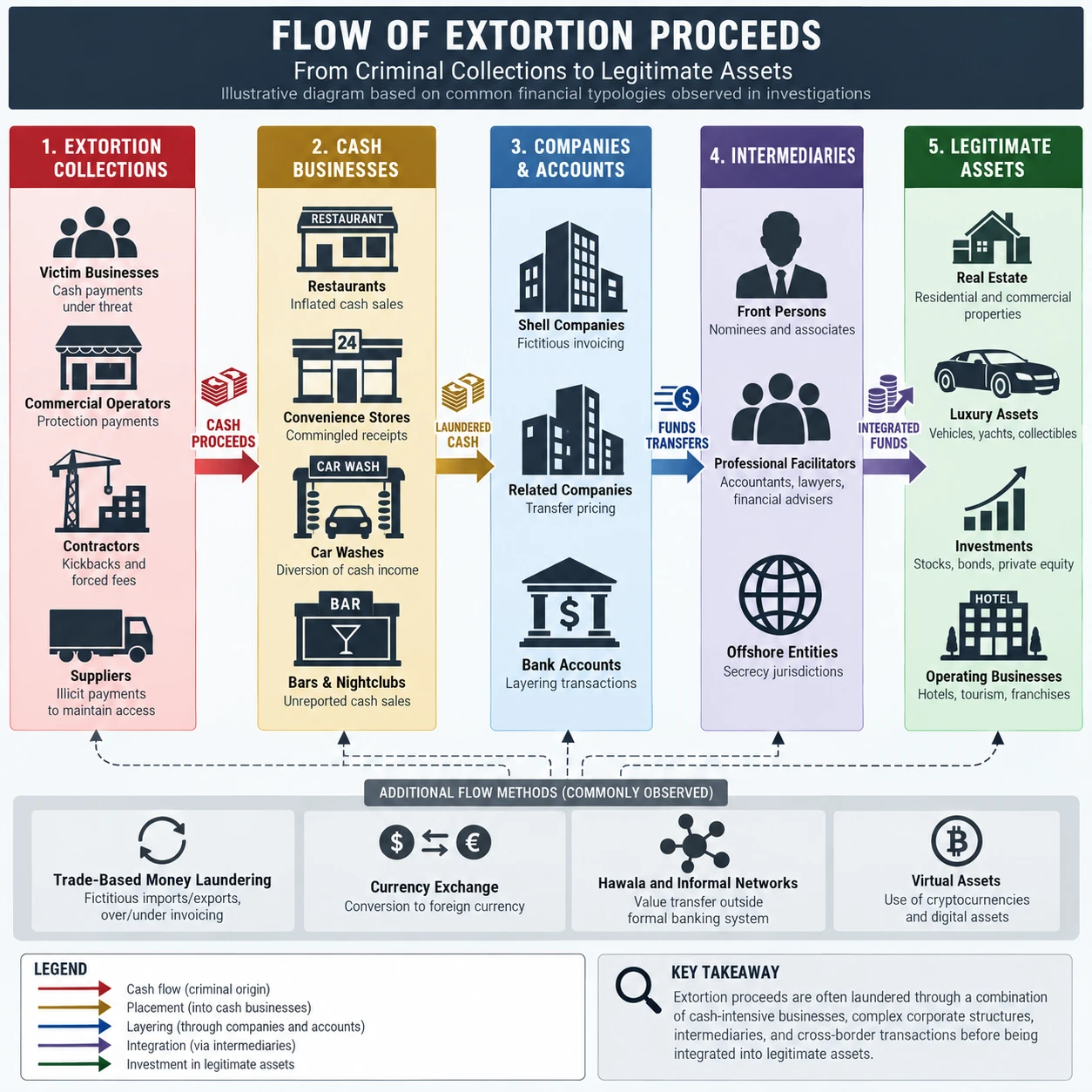
Extortion can generate money through threats, coercion, and repeated demands, but the path from victim payment to criminal use is rarely simple. Understanding possible money laundering channels helps researchers and investigators assess how organized crime groups may disguise extortion proceeds, while recognizing that methods differ across cases and jurisdictions.
How extortion generates and collects criminal proceeds
Extortion proceeds come from payments obtained through threats or coercion, and may arrive as cash, bank transfers, digital payments, or goods. Their financial pattern depends on the scheme, the victims, and how frequently payments are demanded.
Extortion can include demands for protection payments, blackmail, coercive debt collection, threats against businesses, and ransom demands. These forms should not be treated as interchangeable: a one-time payment from an individual may look very different from recurring payments extracted from several businesses. Some victims pay in cash; others use ordinary payment channels under pressure. In certain cases, criminals may also seize property or require services rather than money.
For an organized crime group, the collection itself can produce a revealing record. Repeated deposits, payments from unrelated people to the same recipient, or funds that do not fit a payer’s normal activity may attract attention. But victims may use intermediaries, divide payments, or avoid formal channels because they fear retaliation or do not trust authorities. Those choices can make the proceeds harder to connect to the threat that produced them.
Extortion proceeds carry a coercion context that ordinary commercial revenue does not. Yet coercion alone does not identify a particular transaction as criminal. Investigators need corroborating evidence, such as victim accounts, communications, business records, and financial data, assessed with attention to safety and the possibility of mistaken attribution.
From collection to concealment: the laundering process
Money laundering is often analyzed through placement, layering, and integration: introducing illicit funds into financial or commercial systems, obscuring their origin, and making them appear usable as legitimate wealth. These stages are a useful framework, but real cases may not follow them in a neat sequence.
Placement refers to the point at which proceeds enter a financial or economic channel. For extortion, this may involve cash deposits, transfers through another person, or the use of a business account. Some payments begin in the formal financial system, so placement may be less about depositing cash than about separating a payment from its coercive source.
Layering describes transactions or arrangements that make ownership and origin harder to trace. Investigators may encounter transfers among accounts, companies, or jurisdictions, but a complex transaction is not automatically evidence of laundering. Legitimate businesses also move funds for ordinary reasons, and context matters.
Integration is the use of funds in ways that resemble lawful income or assets, such as spending through a business or acquiring property. The three-stage model helps organize an inquiry, but it should not be mistaken for a mandatory checklist. Funds can be spent quickly, mixed with legitimate revenue, or moved through only one or two stages.
Common channels used to move extortion proceeds
Potential channels include cash-intensive businesses, shell companies, intermediaries, and informal value transfer systems. Their presence is a line of inquiry, not proof that a particular business or person is involved in crime.
Cash-intensive businesses, including some retail and service operations, handle frequent cash receipts that can be difficult to verify transaction by transaction. This creates a vulnerability if illicit cash is mixed with genuine sales. However, cash use is normal in many lawful businesses; investigators need to compare reported income with operating patterns and independent records rather than rely on an industry label.
Shell companies may obscure who controls funds, especially when ownership records are incomplete or spread across multiple entities. A company with little visible business activity can warrant scrutiny when it receives unexplained funds, but legitimate holding companies and special-purpose entities also exist. Beneficial ownership analysis helps establish the natural persons who ultimately own or control an entity, rather than stopping at its registered name.
Other possible channels include money mules, who move funds on behalf of others, and informal value transfer systems that settle value through networks outside conventional bank transfers. These systems can serve legitimate communities and commerce, so their use is not inherently suspicious. The relevant questions concern the transaction’s purpose, source, recipients, and consistency with known activity.
Extortion proceeds may also be mixed with lawful earnings or passed through people and businesses that appear unconnected to the original demand. This can create a chain of apparent normality while weakening the paper trail. Public reporting and case evidence vary, so broad channel categories should not be presented as proof of a specific method in any particular investigation.
Why extortion proceeds create distinctive tracing challenges
Extortion proceeds can be difficult to trace because payments are made under pressure, may be fragmented, and are often underreported. The financial trail may be separated from the threat by intermediaries, legitimate transactions, or victims’ understandable efforts to stay safe.
Fear can delay reporting or lead victims to withhold details, particularly where they expect retaliation, doubt that authorities can protect them, or depend on the threatened business to support a family. A missing complaint therefore does not establish that no extortion occurred. At the same time, an unexplained transfer alone cannot establish coercion; investigators need reliable evidence linking financial activity to the demand.
Fragmented payments also complicate analysis. Several small transactions may relate to one scheme, while similar transactions may reflect ordinary business. If proceeds are combined with legitimate income, accounting records may show a plausible overall balance even when part of the money came from crime. Cross-checking timelines, counterparties, communications, and business activity can help distinguish these possibilities.
There is also a safety trade-off. Rapid financial inquiries can preserve records and identify assets, but poorly planned contact with a victim or suspected payer may expose them to further pressure. Investigative steps should be coordinated with victim-support and protection measures, and conclusions should reflect the limits of incomplete or conflicting evidence.
Red flags and investigative approaches
Useful red flags are patterns that conflict with a customer’s known profile or lack a clear economic purpose; none proves money laundering on its own. Financial intelligence becomes stronger when transaction data is combined with ownership records, business context, and evidence of coercion.
Potential indicators include:
- Repeated payments from unrelated individuals or businesses to a common recipient without an evident commercial relationship.
- Cash activity or revenue that appears inconsistent with a business’s size, operating hours, location, or documented sales.
- Transfers among companies with unclear ownership or little apparent economic activity.
- Use of intermediaries whose transactions do not fit their known income, occupation, or relationship to the parties.
- Changes in payment behavior that coincide with reported threats, demands, or unusual business disruptions.
These indicators are starting points for review, not a scoring shortcut. A business may be seasonal; a person may have a legitimate reason to receive funds; and incomplete records can make ordinary activity look unusual. Applying anti-money laundering (AML) controls fairly means examining explanations and avoiding assumptions based on a person’s community, occupation, or use of cash.
Investigators can compare bank and payment records with company filings, tax and accounting documents where legally available, communications, and victim or witness accounts. Beneficial-ownership analysis can reveal links concealed behind layers of registered entities. Financial intelligence units, law enforcement, regulators, and relevant cross-border partners may each hold part of the picture. Information sharing must follow applicable law and protect sensitive victim data.
Prevention and disruption
Prevention works best when AML controls identify unusual activity without treating ordinary cash use or informal transfers as inherently criminal. Institutions and authorities can reduce vulnerabilities through proportionate monitoring, useful reporting, ownership transparency, and safe routes for victims to seek help.
Financial institutions can assess transactions against a customer’s expected activity, investigate meaningful changes, and document why a pattern is unusual. Effective controls combine automated alerts with informed human review; rigid thresholds can miss linked payments, while overly broad rules can generate false alarms and burden legitimate customers. Staff training should cover coercion-related indicators and safe procedures for handling disclosures.
Companies and professional service providers can maintain accurate ownership information, check whether counterparties make commercial sense, and keep records that support legitimate cash revenue. Regulators and investigators can improve the quality of beneficial-ownership data and coordinate inquiries across agencies. Where evidence supports it, asset tracing and lawful restraint or confiscation measures may disrupt criminal benefit, subject to due process and local law.
Victim safety belongs in the response from the start. Reporting options should be confidential where possible, accessible, and connected to appropriate protection and support. A useful test for any intervention is whether it can both preserve evidence and reduce the risk of further coercion. Disruption is strongest when financial controls, investigation, and victim protection reinforce one another.
Frequently asked questions
What makes extortion proceeds difficult to trace?
Victims may underreport payments because they fear retaliation, and payments can be fragmented, routed through intermediaries, or mixed with lawful income. Financial records alone may not show whether a transfer was made under coercion.
Which broad types of financial channels may be exploited?
Potential channels include cash-intensive businesses, shell companies, money mules, ordinary bank or payment accounts, and informal value transfer systems. Their use can be legitimate; investigators assess the context and evidence rather than treating a channel as proof of wrongdoing.
What role can cash-intensive businesses play in laundering?
They may make it harder to distinguish illicit cash from genuine receipts if funds are mixed. But cash-heavy operations are common in lawful commerce, so revenue patterns must be checked against business records and other evidence.
How can financial institutions identify suspicious patterns?
They can compare activity with the customer’s expected profile, review unexplained counterparties or transaction changes, and investigate alerts using relevant context. Staff should document decisions, avoid assumptions, and follow established procedures for escalating suspected coercion.