Theoretical Models of Extortion Dynamics: A Criminological Perspective
Extortion is one of the oldest forms of organised predation, yet it remains among the least formally theorised within criminology. The gap between rich ethnographic description and rigorous structural modelling has narrowed considerably in recent decades, driven by interdisciplinary projects that bring computational tools to bear on criminal systems. This article maps the theoretical terrain — from foundational criminological frameworks through to agent-based and game-theoretic models — for researchers who need both conceptual vocabulary and methodological orientation.
What Is Extortion as a System?
Extortion, viewed through a systemic lens, is not a series of isolated criminal acts but a self-sustaining structure with defined roles, recursive feedback loops, and emergent properties. The extortion racket persists because it solves a coordination problem for both parties: the extorter supplies a credible threat, and the victim pays to avoid its execution.
This framing — borrowed partly from systems theory and partly from economic sociology — identifies at least three structural components: a coercion mechanism, a compliance-extraction interface, and a regulatory logic that governs territorial or sectoral boundaries. Understanding extortion as a system means tracing how these components interact, not just cataloguing individual acts of intimidation.
Extortion racket systems also exhibit recognisable lifecycle patterns. They emerge in environments where formal protection is absent or distrusted, stabilise around repeated enforcement of implicit contracts, and can collapse when the credibility of the threat is undermined — by law enforcement, rival organisations, or internal defection. Modelling these dynamics requires frameworks capable of capturing feedback, non-linearity, and adaptive behaviour.
Criminological Foundations: Theory Before Modelling
Formal modelling of extortion dynamics is grounded in classical criminological theory, particularly rational choice, deterrence, and opportunity structure frameworks. These traditions provide the behavioural assumptions that computational models later operationalise.
Rational choice theory, associated with Cornish and Clarke's situational crime prevention work, treats offenders as utility-maximisers who weigh costs and benefits. In the extortion context, this maps directly onto decisions about target selection, threat calibration, and payment enforcement. The extorter is not irrational — they are responding to structural incentives.
Deterrence theory contributes a different axis. Classical deterrence focuses on certainty, severity, and celerity of punishment, but extortion modelling reveals a more complicated picture: deterrence operates bidirectionally. Victims may also deter extorters through resistance, and the state deters both through enforcement. The interaction between these deterrence mechanisms generates outcomes that no single-actor framework can capture.
Strain theory, in its structural variants, helps explain where rackets take root. Merton's anomie tradition and later institutional anomie theory (Messner and Rosenfeld) situate organised crime in contexts where legitimate opportunity structures are blocked or devalued. This is less a modelling framework than a contextual anchor — it explains the supply of recruits and the social tolerance that allows rackets to persist.
Game-Theoretic Approaches to Extortion Dynamics
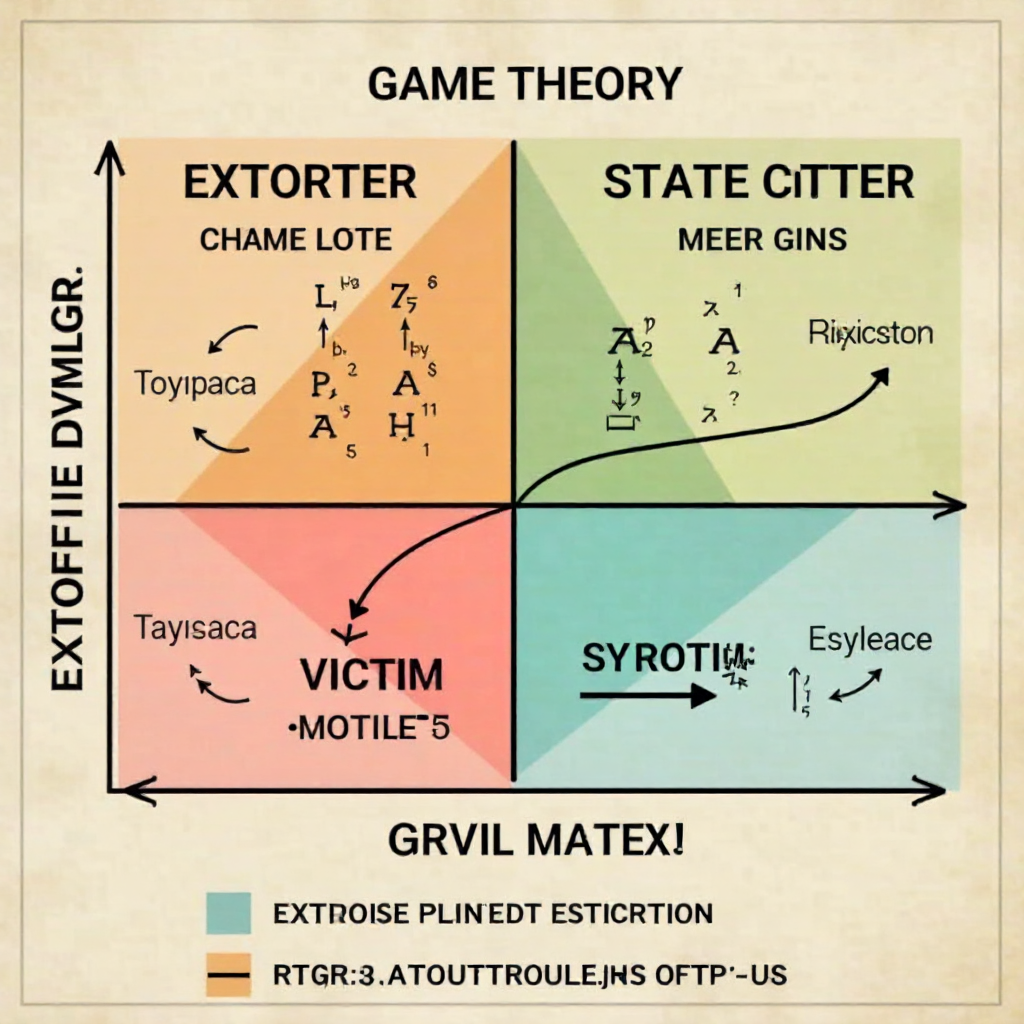
Game theory provides the most analytically precise tools for modelling the strategic interactions at the core of extortion. The key contribution is the formalisation of threat credibility — a concept that is intuitively obvious but surprisingly difficult to operationalise.
In a one-shot interaction, extortion is a straightforward sequential game: the extorter threatens, the victim pays or resists, the extorter follows through or does not. The problem is that following through is costly, which means threats can be empty. Backward induction quickly reveals that rational victims should resist, and rational extorters should never threaten — a result that clearly fails empirically.
Repeated games resolve this paradox. When interactions recur over time, extorters have an incentive to build a reputation for enforcement, and victims have an incentive to comply to avoid escalation. The folk theorem formalises the range of equilibrium outcomes in infinitely repeated games, showing that cooperation (compliance) can be sustained through the threat of future punishment. This captures something real about how protection rackets function: they are reputation systems as much as coercion systems.
Game-theoretic models have also been extended to include the state as a third strategic actor. Triadic frameworks — extorter, victim, law enforcement — produce richer equilibrium landscapes, including the possibility of partial enforcement equilibria where rackets persist despite active policing. The Schelling-influenced literature on organised crime as a provider of governance in ungoverned spaces draws heavily on this tradition.
Agent-Based Models and Emergent Racket Structures
Agent-based modelling (ABM) addresses what game theory cannot: the emergence of macro-level racket structures from micro-level interactions among heterogeneous agents. This is the methodological centrepiece of research programmes like GLODERS (Global Dynamics of Extortion Racket Systems).
In an ABM, individual agents — extorters, victims, law enforcement officers, potential recruits — are assigned behavioural rules and placed in a simulated environment. The model runs iteratively, and researchers observe what structures emerge without specifying them in advance. This approach is particularly valuable for extortion research because racket organisations are not designed from the top down; they grow, adapt, and die in response to local conditions.
The GLODERS project, which examined extortion dynamics comparatively across Sicily, Campania, Japan, and other contexts, used ABM to test whether different initial conditions and enforcement regimes could reproduce the empirically observed variation in racket structure. The capacity to run controlled simulations — varying, say, the rate of victim solidarity or the efficiency of law enforcement — makes ABM a genuinely experimental tool in a field where field experiments are ethically and practically impossible.
One limitation worth acknowledging: ABMs are sensitive to their initial behavioural assumptions. If the rules governing agent behaviour are poorly calibrated to empirical data, the emergent structures may be artefacts of the model rather than reflections of reality. Validation against field data — court records, police reports, ethnographic accounts — is essential and remains an ongoing methodological challenge.
Protection Markets: The Economic Dimension
Extortion can be modelled as a market — specifically, a market for protection services where the supplier has a monopoly on coercive capacity in a given territory. This framing, developed most influentially by Diego Gambetta in his analysis of the Sicilian Mafia, reframes the extortion relationship as a distorted but recognisable economic exchange.
In protection market models, the racket organisation is a firm that produces a service (guaranteed physical safety and contract enforcement) and charges a price (the pizzo or protection fee). Demand for this service is not entirely involuntary — in environments where the state fails to provide security, some businesses genuinely prefer private protection to no protection. This complicates the moral framing but improves the analytical one.
Price-setting in protection markets follows unusual logic. Unlike competitive markets, the extorter's monopoly means prices are limited primarily by the victim's ability to pay and the availability of exit options (relocation, closure, or appeal to rival protection). The absence of competition keeps prices high; the need to sustain compliance over time prevents prices from becoming confiscatory. Rackets that overprice face defection or resistance, which destroys the revenue stream.
Economic models also illuminate the supply side: why individuals enter extortion as a profession, how racket organisations recruit and retain enforcers, and what determines the boundary of territorial control. Labour market models adapted from industrial organisation have been applied to criminal organisations with notable success, particularly in explaining the wage structures within hierarchical rackets.
Network Structure and Organisational Resilience
Social network analysis (SNA) reveals the structural properties that determine whether an extortion organisation can survive enforcement pressure, internal conflict, or leadership removal. The key insight is that organisational resilience is a property of network topology, not individual capability.
Research on criminal networks consistently finds that extortion organisations exhibit hybrid structures: centralised enough to coordinate enforcement and revenue collection, but sufficiently decentralised to maintain operational security. Purely centralised networks are efficient but fragile — remove the hub, and the network collapses. Purely decentralised networks are resilient but struggle to maintain the credible threat that sustains compliance.
Betweenness centrality — the degree to which a node lies on paths connecting other nodes — is a reliable predictor of both influence and vulnerability within criminal networks. Law enforcement agencies have increasingly used network disruption strategies targeting high-betweenness individuals rather than simply the most visible leaders. Theoretical models inform these strategies by simulating the effect of targeted removal on network connectivity and racket functionality.
SNA also captures the embeddedness of extortion organisations within legitimate social structures. Rackets do not float free of communities — they are woven into local economies, family networks, and political systems. This embeddedness is part of what makes them resilient and part of what makes disruption socially costly.
Implications for Policy Modelling and Disruption Strategies
Theoretical models generate policy-relevant outputs only when they are connected to realistic intervention mechanisms. The modelling literature converges on several findings that challenge conventional enforcement intuitions.
First, targeting visible leadership is less effective than targeting the enforcement layer — the mid-level operatives who carry out actual coercion. Game-theoretic models show that removing enforcers directly undermines threat credibility, which is the mechanism sustaining compliance. Removing leaders often produces succession, not collapse.
Second, victim solidarity is a surprisingly powerful disruption variable. ABM simulations in the GLODERS framework demonstrated that increasing the probability that victims would report or resist collectively — through witness protection programmes, business associations, or cultural shifts — could tip racket systems from stable equilibria toward dissolution faster than equivalent increases in enforcement intensity.
Third, all current models acknowledge significant predictive limits. Racket systems are adaptive: organisations learn, adjust pricing, shift territories, and alter recruitment in response to pressure. Models that treat the criminal organisation as a static target systematically underestimate recovery rates after disruption. Building adaptive behaviour into both theoretical and computational models remains an active research frontier.
The translation from model to policy also requires careful attention to context. Parameters calibrated for Palermo will not transfer directly to Tokyo or Bogotá without adjustment. The value of comparative modelling projects like GLODERS lies precisely in their capacity to identify which structural dynamics are universal and which are locally specific — a distinction that matters enormously for transferring intervention strategies across jurisdictions.
Frequently Asked Questions
What distinguishes extortion modelling from general organised crime modelling?
Extortion modelling focuses on the continuous, relational structure of protection rackets — the repeated coercion-compliance dynamic — rather than discrete transactional crimes like drug trafficking or fraud. This makes the enforcement of implicit contracts, threat credibility, and territorial governance central concerns, which require distinct game-theoretic and systemic frameworks.
How do agent-based models handle victim compliance and resistance?
ABMs typically encode victim agents with threshold rules: compliance occurs when the expected cost of resistance exceeds the payment demanded, adjusted for the probability of enforcement. Resistance can be modelled as individual or collective, with network effects — one resisting victim can shift the calculus for neighbours. Calibrating these thresholds against empirical data is one of the key methodological challenges.
What role does the state or law enforcement play in extortion dynamic models?
Law enforcement enters models as a third strategic actor whose presence alters equilibrium outcomes for both extorters and victims. In game-theoretic frameworks, enforcement probability shifts the cost-benefit calculation for extorters. In ABMs, law enforcement agents can be modelled with their own resource constraints, detection probabilities, and strategic priorities, allowing researchers to simulate different policing regimes and their structural effects.
Can theoretical models predict the emergence of new extortion rackets?
Current models can identify structural conditions — weak state presence, blocked legitimate opportunity, low victim solidarity, available enforcement labour — that are associated with racket emergence. Prediction in a strong sense remains beyond reach: models generate probability distributions over outcomes, not forecasts of specific organisations in specific places. The honest position is that models inform risk assessment rather than prediction.
How does GLODERS contribute to comparative cross-national extortion research?
The GLODERS project, funded under the EU Seventh Framework Programme, developed a shared theoretical vocabulary and computational platform that allowed researchers to compare extortion dynamics across culturally and institutionally distinct settings. Its contribution is methodological as much as empirical: by standardising how key variables are defined and operationalised, it enables systematic comparison that anecdotal or case-study approaches cannot support.