The GLODERS Framework: A Structural Approach to Analyzing Transnational Extortion Networks
Extortion rackets have operated across borders for decades, yet criminologists have long lacked a unified analytical vocabulary for comparing them. The GLODERS project — Global Dynamics of Extortion Racket Systems — was developed precisely to fill that gap, offering a systematic framework for studying how extortion functions as an organized, recurring enterprise rather than a series of isolated criminal acts.
What Is the GLODERS Project?
GLODERS is a comparative criminology research initiative designed to model extortion racket systems across multiple national contexts. Its core objective is to move beyond single-country case studies and build an analytical architecture that allows researchers to identify structural similarities and differences in how extortion networks form, sustain themselves, and interact with the societies they operate in.
The project emerged from a recognized need in organized crime research: existing frameworks were either too jurisdiction-specific to generalize, or too abstract to be operationally useful. GLODERS occupies the space between those extremes. It draws on protection market theory, institutional analysis, and comparative criminology to produce research infrastructure — concepts, variables, and measurement tools — that can be applied consistently across cases from Southern Italy to Central America to Southeast Asia.
Crucially, this is an academic research framework, not a law enforcement instrument. Its value lies in building cumulative knowledge about extortion as a social and economic phenomenon, not in directing investigative operations.
Defining the Object of Study: Extortion Rackets and Protection Markets
An extortion racket, in the GLODERS sense, is not simply a threat followed by a payment. The framework draws a deliberate distinction between opportunistic extortion — a one-off demand by an individual criminal — and a racket system, which is structured, repeated, and organizationally maintained over time.
The analytical lens GLODERS uses to make sense of this distinction is protection market theory, developed most influentially by economist Diego Gambetta in his study of the Sicilian Mafia. In this model, criminal organizations are not merely predators extracting resources from victims — they are suppliers of a commodity: protection. Whether that protection is genuine, symbolic, or entirely coerced is itself a variable the framework tracks.
This framing has real analytical consequences. It shifts attention from individual criminal acts to the market structure that sustains them: Who are the suppliers? Who are the buyers? What determines the price of compliance? How does competition between protection suppliers shape the racket's behavior? These questions are not answerable through a purely legalistic definition of extortion, which is one reason GLODERS develops its own working concepts rather than deferring to national criminal codes.
Core Analytical Dimensions of the Framework
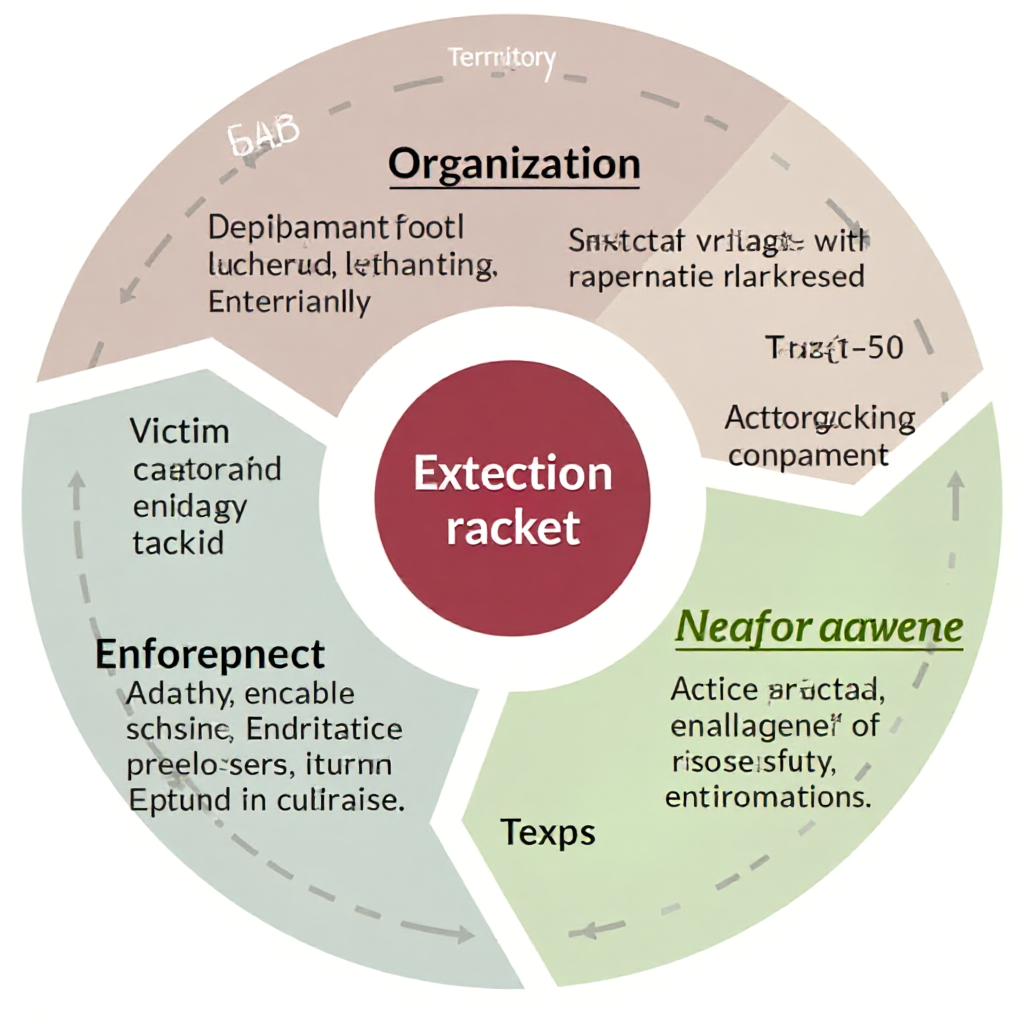
GLODERS structures its comparisons around several primary analytical dimensions that together describe the architecture of any given extortion racket system.
- Organizational form: Is the racket operated by a hierarchical mafia-type organization, a looser network, or a franchise-like structure where enforcement capacity is sub-contracted?
- Territoriality: Does the organization claim exclusive control over a defined geographic area, or does it operate across overlapping or contested spaces?
- Victim relations: How is the extortion demand communicated, negotiated, and enforced? Is there a long-term relationship between extorter and victim, or are interactions transactional and impersonal?
- Enforcement mechanisms: What sanctions does the organization use to ensure victim compliance — and how visible is the violence involved?
- Legitimation strategies: Does the organization cultivate any degree of social consent or rely purely on coercion?
These dimensions are not independent. Territorial monopoly, for instance, tends to correlate with more stable victim relations and lower visible violence — because the threat alone becomes credible. Where territorial control is contested, enforcement costs rise and violence becomes more overt. The framework is designed to map these interdependencies, not just catalog individual features.
Transnational Dynamics: Why Cross-National Comparison Matters
Extortion rackets vary substantially across jurisdictions, and understanding that variation is one of the central contributions the GLODERS framework makes to criminological knowledge. The same organizational form — a mafia-type organization demanding regular payments from local businesses — can look structurally similar in Naples and in Monterrey while operating through entirely different social logics, legitimation strategies, and state relationships.
Cross-national comparison exposes what country-level studies cannot: which features of extortion rackets are contingent on local conditions (weak state institutions, specific migration patterns, particular economic sectors) and which appear across radically different contexts. That distinction matters enormously for theory-building. If victim compliance is high in both low-state-capacity environments and high-state-capacity ones, the explanation cannot rely solely on state weakness.
The transnational dimension also captures something that purely national frameworks miss: how extortion networks themselves operate across borders. Diaspora communities, migration corridors, and international trade routes all create pathways through which racket systems expand, transplant, or evolve. GLODERS treats this mobility as a subject of analysis rather than an exception to be explained away.
Criminal Governance and Territorial Control
The GLODERS framework treats mafia-type organizations not merely as criminal enterprises but as governance actors — entities that regulate behavior, resolve disputes, and enforce rules within a defined territory, in partial substitution for state institutions. This concept of criminal governance is central to how the framework explains the persistence and social embeddedness of extortion rackets.
Where a criminal organization achieves stable territorial control, it tends to develop governance functions beyond pure extortion: mediating business disputes among local traders, regulating access to local labor markets, controlling petty crime within its territory. These functions are not incidental — they are part of how the organization maintains legitimacy and reduces the enforcement costs of the protection racket itself.
This perspective, drawing on scholars like political scientists who study criminal governance in parallel with criminology, has proven generative for comparative analysis. It explains why some extortion rackets survive and expand while others remain predatory and unstable. Organizations that govern tend to build durable victim compliance; organizations that only extract tend to generate resistance, defection, or violent counter-reaction.
The trade-off is real: adopting a governance lens risks overstating the stability or coherence of criminal organizations. GLODERS acknowledges this by treating criminal governance as a variable, not a given — some organizations achieve it, others do not, and the framework maps where on that spectrum any given racket system sits.
Methodological Approach and Research Design
GLODERS operationalizes its conceptual framework through a multi-method research design that combines qualitative depth with comparative breadth. No single methodology dominates — the project's strength lies in how it triangulates across different evidence types.
The core methods include:
- Qualitative case studies of specific extortion racket systems, typically combining court records, investigative documents, and fieldwork
- Expert interviews with researchers, former law enforcement officials, and practitioners with direct knowledge of specific contexts
- Comparative datasets built around the framework's analytical dimensions, allowing systematic cross-case analysis
What makes the methodology distinctive is its insistence on conceptual precision before data collection. The framework's definitions — of extortion racket, protection market, territorial control, victim compliance — are operationalized consistently across national contexts, so that comparisons are genuine rather than superficial. This is harder than it sounds: the same surface behavior (a monthly payment from a shopkeeper to a criminal organization) can mean structurally different things in different contexts, and the framework is designed to capture that difference rather than flatten it.
The design also acknowledges its own limitations. Organized crime research faces persistent problems of data access and informant reliability. GLODERS addresses this through source triangulation and explicit uncertainty coding rather than by claiming false precision.
Implications for Policy and Future Research
The GLODERS framework's most immediate contribution is to organized crime research itself: it provides a shared vocabulary and a set of comparable variables that allow findings from one context to inform hypotheses in another. That cumulative function is what research infrastructure is supposed to deliver, and it has been largely absent from extortion studies until relatively recently.
For policy audiences, the framework's implications are indirect but real. Understanding whether an extortion racket is governance-based or purely predatory, whether victim compliance is driven by fear or by perceived utility, whether the organization has territorial monopoly or operates in a contested market — these distinctions have direct consequences for what interventions are likely to work. A policy designed for a pure extraction racket will fail, possibly catastrophically, when applied to a criminal governance system where the population has partly internalized the organization's legitimacy.
Future research directions opened by the framework include studying racket system evolution over time (how do protection markets destabilize and reconstitute?), the role of digital infrastructure in transnational extortion, and the conditions under which criminal governance transitions into or out of political engagement. Each of these threads extends naturally from the analytical dimensions GLODERS has already mapped.
Frequently Asked Questions
What distinguishes GLODERS from other organized crime research frameworks?
GLODERS focuses specifically on extortion racket systems as its unit of analysis, rather than treating organized crime as a monolithic category. Its defining feature is comparative infrastructure: shared concepts, operationalized variables, and multi-method design applied consistently across national contexts, enabling genuine cross-national comparison rather than parallel single-country studies.
How does GLODERS define "extortion" compared to standard legal definitions?
Standard legal definitions of extortion focus on the individual criminal act — a threat, a demand, a payment. GLODERS defines extortion at the system level: a structured, recurring arrangement in which an organization extracts payments by supplying (or claiming to supply) protection. This distinction separates opportunistic extortion from organized racket systems, which have different causes, structures, and policy implications.
Which countries or regional contexts does the GLODERS framework cover?
The framework is designed for broad cross-national application. In practice, research using GLODERS concepts has engaged contexts including Italy, Germany, the United Kingdom, Japan, the United States, and Latin American countries. The framework's comparative logic means it can be applied wherever a structured extortion racket system can be identified and documented.
How can researchers apply the GLODERS framework to new case studies?
Researchers can apply the framework by operationalizing its core analytical dimensions — organizational form, territoriality, victim relations, enforcement mechanisms, and legitimation strategies — for their target context, then using the framework's conceptual vocabulary to situate their findings within the comparative literature. The key requirement is definitional consistency: using GLODERS concepts as they are defined, not substituting locally common but analytically different terms.
What is the relationship between protection markets and criminal governance in the GLODERS model?
Protection market theory provides the economic logic for why extortion rackets form and persist. Criminal governance describes what happens when that market relationship stabilizes and the supplying organization begins to perform broader regulatory functions. In the GLODERS model, governance emerges from successful protection market operation — it is the political dimension of a durable economic arrangement, not a separate phenomenon.