The Evolution of Extortion Racket Systems in Global Organized Crime: Structures, Dynamics, and Research Perspectives
Defining Extortion Racket Systems: Beyond Simple Predation
An extortion racket system is a structured, rule-governed arrangement through which an organized group extracts payments from individuals or businesses in exchange for protection — real, fabricated, or both. This distinguishes it fundamentally from opportunistic extortion, which is episodic, unregulated, and typically non-iterated.
The conceptual gap matters. Where a single actor demands money under threat, a racket system implies institutional continuity: repeated transactions, codified expectations between extorter and victim, and an underlying logic of quasi-contractual obligation. Victims pay not just to avoid harm but because the system has established credibility over time.
Criminologists draw on the concept of protection markets to frame this analytically. Diego Gambetta's work on the Sicilian Mafia remains foundational here — the racket as a commodity market in which violence, or its credible threat, is the product being sold. Organized crime groups operating these systems are not simply predators; they are, in a distorted sense, service providers within a coercive governance framework.
This theoretical grounding is essential for comparative research. Without it, analysts risk conflating structurally distinct phenomena — lumping street-level shakedowns together with the sophisticated, multi-tiered extortion architectures operated by groups like the Camorra in Naples or the Ndrangheta in Calabria.
Historical Trajectories: From Local Rackets to Transnational Networks
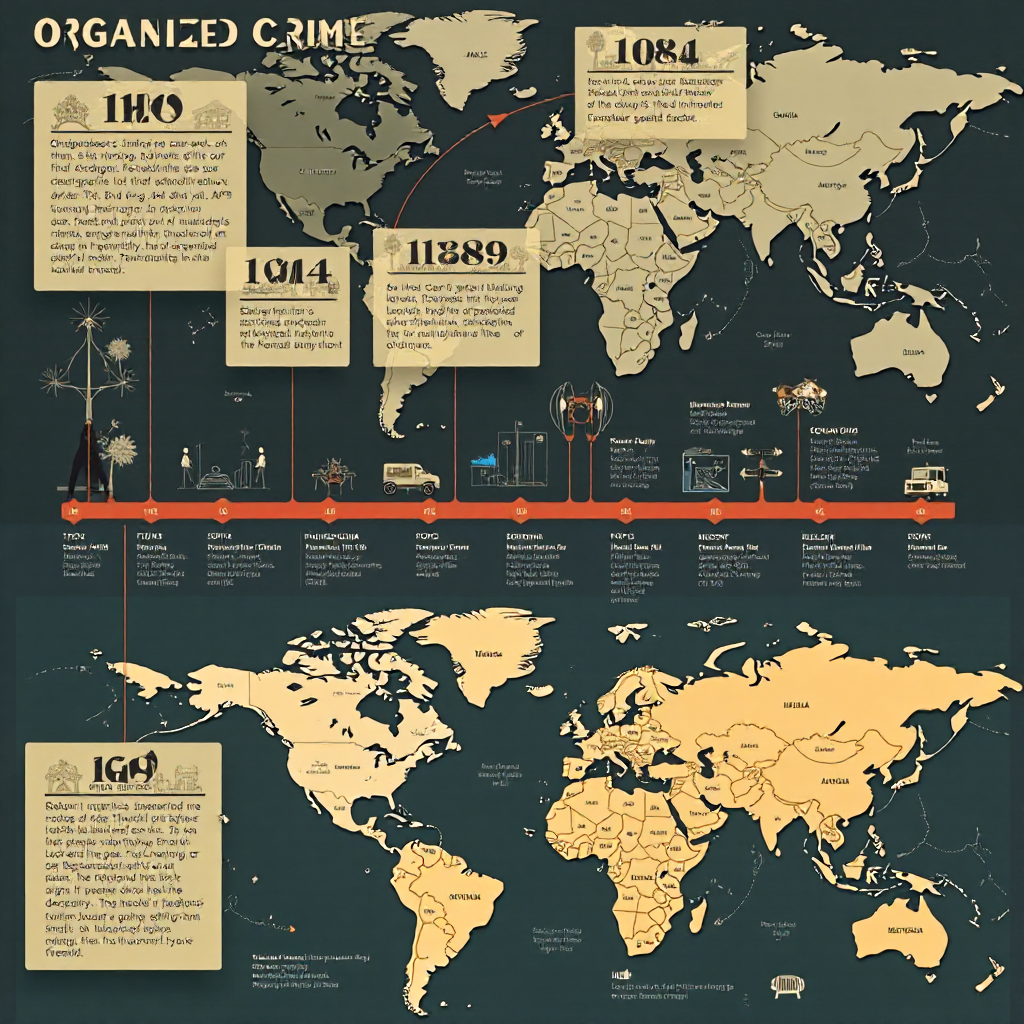
Extortion racket systems have moved from geographically bounded, ethnically homogeneous operations in early 20th-century urban environments to networked, cross-border structures embedded in global economies. The trajectory is neither linear nor universal — but the structural pressures driving it are consistent.
Early organized protection rackets in cities like New York, Palermo, and Chicago were intensely local. They depended on dense social ties, neighborhood legitimacy, and the near-total absence of state policing in certain communities. The racket worked because the group was known, embedded, and consequential within a defined territory.
Post-war migration, decolonization, and economic globalization began fracturing this model. Criminal organizations that had built their authority on territorial control found themselves operating across jurisdictions, managing diaspora communities, and competing with groups they had never encountered. The Yakuza's internationalization in the 1980s and 1990s, and MS-13's expansion across Central America and into the United States, illustrate how extortion systems travel — sometimes through explicit organizational transplantation, sometimes through looser networks of shared identity and mutual benefit.
What persists across these transitions is the underlying institutional logic: the need to establish credibility, manage enforcement, and maintain a stable revenue relationship with victim populations. The geography changes; the organizational problem does not.
The Internal Logic of Racket Systems: Hierarchy, Rules, and Enforcement
Extortion racket systems sustain themselves through internal governance — not just violence directed outward at victims, but discipline, rules, and enforcement mechanisms that regulate behavior within the group itself.
This internal logic serves a practical function. Rogue members who extort excessively or behave unpredictably undermine the system's credibility with victims. If payments don't actually buy protection, the market collapses. Effective racket organizations therefore develop internal compliance mechanisms: codes of conduct, sanctioning systems, and hierarchies that assign accountability for specific territories or victim pools.
The Ndrangheta's cellular structure — loosely federated 'ndrine bound by blood ties — illustrates how internal rules can be maintained without a single central authority. Each cell operates semi-independently, but shared norms around violence, omertà, and territorial respect keep the broader system coherent. This decentralization also provides adaptive resilience: dismantling one cell rarely unravels the whole.
Managing the relationship with victims is equally structured. Research on Camorra extortion in Naples has documented how racket collectors operate on defined schedules, adjust demands in response to a business's visible economic performance, and occasionally mediate disputes between victims and other criminal actors. The relationship, perversely, has service characteristics.
Territorial Control and Competition Between Extortion Groups
Territorial control is the spatial foundation of most extortion racket systems. A group that cannot credibly claim dominance over a defined area cannot deliver on the implicit promise of protection — and its extortion market collapses.
The relationship between territorial monopoly and violence is one of the more counterintuitive findings in extortion research. Where a single organized crime group exercises unchallenged control over a territory, violence levels tend to be lower. Victims pay because the threat is credible and the alternative — non-payment — is predictable. Competitive extortion markets, by contrast, drive violence upward: groups fight over victim pools, victims face multiple simultaneous demands, and the enforcement logic breaks down into open conflict.
This dynamic has been documented across contexts as different as Naples, San Salvador, and parts of urban Mexico. It has significant policy implications. Law enforcement strategies that fragment dominant criminal organizations without eliminating them can inadvertently produce more violent, less stable environments — a trade-off that policing agencies rarely model explicitly.
Geography also shapes which sectors become extortion targets. Construction, retail, and transport are typical victim industries because they are spatially fixed and economically visible. Digital or mobile businesses present different challenges to racket systems, and there is emerging evidence that some groups are adapting their models accordingly.
Adaptation Under Pressure: Law Enforcement, Migration, and Globalization
Extortion racket systems exhibit strong adaptive resilience — the capacity to restructure organizational form, geographic scope, or victim strategy in response to external shocks without losing core institutional function.
Law enforcement pressure is the most studied driver of adaptation. Large-scale prosecutions of the Italian-American Cosa Nostra during the 1980s and 1990s did disrupt extortion operations, but successor groups and affiliates absorbed portions of the activity. More distributed network structures proved harder to prosecute comprehensively. The lesson many organized crime groups appear to have internalized is that organizational flatness is a form of legal resilience.
Migration creates a different adaptive pressure. When communities with established protection market relationships relocate — voluntarily or under duress — the extortion infrastructure sometimes follows. Ndrangheta presence in northern Italy, Germany, and Canada developed partly through this mechanism. The group leveraged social trust within Calabrian diaspora communities to re-establish extortion relationships in new geographic settings.
Globalization of criminal markets introduces complexity that older racket models weren't built for. Transnational organized crime groups now operate across legal systems, currencies, and enforcement environments simultaneously. Some have responded by professionalizing — hiring legal expertise, using financial instruments, and operating through legitimate business fronts. The extortion racket, in these cases, becomes embedded within a broader portfolio of criminal and semi-legal activities.
Modelling Extortion Dynamics: The GLODERS Research Agenda
Computational modelling has opened new analytical terrain for extortion racket research. The GLODERS (Global Dynamics of Extortion Racket Systems) project represents a significant effort to move beyond descriptive criminology toward formal, generative models of how extortion systems emerge, stabilize, and evolve.
Agent-based modelling (ABM) is central to this approach. Rather than modeling extortion as an aggregate statistical phenomenon, ABM populates simulated environments with individual actors — extorters, entrepreneurs, enforcers, and state agents — each following defined behavioral rules. Macro-level patterns (violence rates, territorial stability, racket revenue) emerge from micro-level interactions rather than being assumed in advance.
This matters for several reasons. Extortion dynamics are non-linear: small changes in enforcement intensity or victim resistance can produce disproportionate systemic effects. ABM can explore these threshold dynamics in ways that regression analysis cannot. GLODERS research has used this framework to test hypotheses about when monopoly extortion is stable, what conditions produce competitive fragmentation, and how anti-racket policies propagate through organizational networks.
The simulation approach also supports cross-regional comparison in a principled way. Rather than assuming that findings from Naples transfer directly to San Salvador, researchers can parameterize models to reflect different institutional contexts and test whether the same structural logic produces comparable outcomes. This comparative, model-driven methodology is what distinguishes the GLODERS agenda from earlier, more descriptive work in organized crime studies.
Open Questions and Future Research Directions
Despite significant advances, extortion racket research faces persistent gaps — in data, theory, and methodology — that limit the field's analytical reach.
The most fundamental is the data problem. Extortion is systematically underreported. Victims fear retaliation; businesses prefer informal resolution; police statistics capture only a fraction of actual activity. This creates selection biases in almost every empirical study. Research designs that rely on victim surveys, court records, or informant testimony each introduce different distortions that are difficult to correct for comparatively.
Theoretically, the field still lacks consensus on how to model victim agency. Most frameworks treat victims as passive actors responding to extortion demands. But fieldwork — particularly in contexts like Mexico and Central America — shows victims making complex strategic calculations: which group to pay, how much, when to report, when to relocate. Integrating victim decision-making into formal models is an underexplored priority.
The digital transition poses questions that existing theory handles poorly. Extortion in online spaces, through ransomware and cyber-enabled coercion, shares some structural features with traditional rackets but operates without territorial anchoring. Whether these constitute new extortion racket systems or fundamentally different phenomena remains contested.
Finally, there is the challenge of policy translation. Simulation models and theoretical frameworks need pathways into law enforcement and prevention practice. Building those bridges — between formal modelling communities, empirical criminologists, and practitioners — is perhaps the most consequential research agenda the field currently faces.
Frequently Asked Questions
What distinguishes an extortion racket system from opportunistic extortion?
An extortion racket system is an institutionalized, repeating structure with defined rules, stable victim relationships, and internal enforcement mechanisms. Opportunistic extortion is a one-off transaction with no ongoing organizational logic behind it. The racket system persists; opportunistic extortion does not.
How do organized crime groups maintain extortion operations across national borders?
Transnational extortion typically relies on diaspora networks, shared ethnic or organizational identity, and the replication of proven institutional models in new contexts. The Ndrangheta's expansion into northern Europe followed this pattern. Digital communication has also reduced the coordination costs of managing cross-border victim relationships.
What role does territorial control play in the stability of extortion markets?
Territorial monopoly tends to stabilize extortion markets by giving the dominant group credible enforcement capacity and reducing competition-driven violence. When territorial control is contested, extortion markets become more volatile, victims face multiple simultaneous demands, and violence increases as groups compete over victim pools.
How does agent-based modelling contribute to understanding extortion racket evolution?
Agent-based modelling allows researchers to simulate extortion dynamics from the ground up — individual actors following behavioral rules, with macro patterns emerging from their interactions. This approach is particularly useful for studying non-linear dynamics, threshold effects, and the comparative impact of different policy interventions across institutional contexts.
Which real-world criminal organizations are most studied in extortion racket research?
The Camorra and Ndrangheta in Italy are the most extensively studied due to the availability of judicial records and ethnographic research. MS-13, the Yakuza, and various Mexican cartel structures are also significant comparative cases, each offering distinct organizational models, geographic contexts, and victim relationship patterns relevant to extortion racket analysis.